
Shelby Projected Versus Actual Release
TDOC FOIL does not publish a field literally called Projected Release Date or Tentative Release Date. It publishes `Release Eligibility Date` and `Sentence End Date`. Release Eligibility Date, often shortened to RED, is the earliest point at which an eligible felony prisoner may be considered for parole. It is not a scheduled exit. Sentence End Date is the endpoint in TDOC’s current sentence record, which can differ from the day the person physically leaves prison.
A person held before trial generally has no set sentence-based release date. Bond, release on recognizance, dismissal, a new court order, or later sentencing can change the path. A person serving a short county misdemeanor sentence belongs with SCDC and the sentencing court. A qualifying state felony calculation belongs with TDOC even when some felony time is served in a local jail or workhouse.
Find Shelby Release Date Records
Begin with the judgment and custody class. Do not apply a TDOC percentage to a pretrial booking or assume that a county discharge clock predicts eligibility.
- Obtain the Tennessee judgment and note the offense, offense date, sentence length, offender range, concurrent or consecutive terms, and jail credit.
- For a TDOC felony record, open FOIL and search by TDOC ID, SID, or name.
- Verify the person through birth date, identifiers, aliases, and photograph or no-photo result.
- Read `Release Eligibility Date`, `Sentence End Date`, `Parole Hearing Date`, `Parole Hearing Result`, and `Supervision Status` without renaming them.
- For SCDC or a short local sentence, contact inmate records and the sentencing court for the local calculation and actual discharge.
- Ask TDOC Records Management for the sentence-computation and archived release documents when the public fields are not enough.
FOIL warns that dates may change as additional court papers arrive. An archived request can seek the release or discharge date and type, sentence calculation, discharge certificate, parole-release papers, and historical location entries. TDOC says archive-search charges may apply and asks requesters not to prepay before receiving instructions.
Shelby FOIL Release Date Fields
FOIL covers Tennessee felony offenders currently or formerly within TDOC custody or supervision. It does not cover every Shelby arrest, misdemeanor, bond release, or municipal hold. The exact fields provide context that a single date cannot.
| FOIL field | Meaning |
|---|---|
| Supervision Status | Shows incarceration, parole, probation, inactive, or another reported state. |
| Assigned Location | Identifies a prison or community-supervision assignment. |
| Sentence Begin Date | Shows the start used in the state record. |
| Sentence End Date | Shows the endpoint in TDOC’s current calculation. |
| Release Eligibility Date | Shows earliest parole consideration when legally eligible. |
| Parole Hearing Date | Shows a scheduled Board proceeding, not release. |
| Parole Hearing Result | Shows the reported Board outcome, not the door-exit event. |
The image below comes from the official FOIL search.
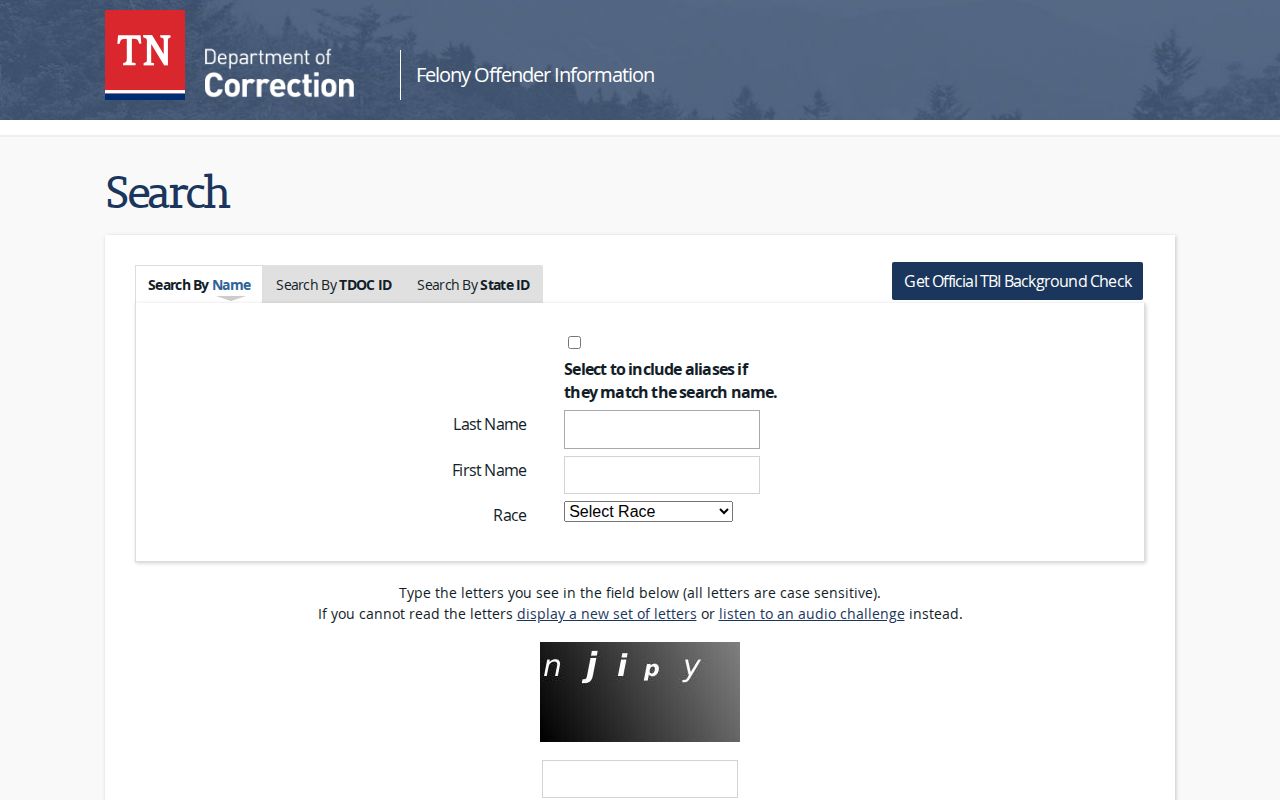
It shows the separate name, TDOC ID, and SID search routes used before reading eligibility and sentence-end data on a matching record.
Shelby Release Date Calculation
A sentence calculation starts with the judgment. TDOC considers the offense and offense date, the sentence term, offender range or release percentage, concurrent and consecutive structure, and documented jail credit. Tennessee Code Annotated § 40-35-501 assigns key felony calculations to TDOC, including qualifying felony confinement in a local jail or workhouse for one year or more.
Ordinary range percentages in the cited 2024 text include 20 or 30 percent for especially mitigated treatment, 30 percent for Range I, 35 percent for Range II, 45 percent for Range III, and 60 percent for a career offender. Offense-specific and date-specific rules override that framework. Some offenses use an 85 percent structure, while others require 100 percent or special floors. Tennessee cannot be summarized as a universal “serve 85 percent” state.
Life without parole has no RED. Life sentences and serious offenses have date-sensitive rules. Missing sentencing papers also matter. The cited statute bars qualifying release until TDOC has received the required documents and required notice has occurred. Never calculate a named person’s exit from a general percentage. Compare the current official law, judgment, and TDOC record.
Shelby Release Credits and Limits
Tennessee Code Annotated § 41-21-236 provides the principal sentence-reduction-credit framework. Documented monthly credits may total up to 16 days, with no more than eight for good institutional behavior and eight for satisfactory program performance. Awards depend on documentation and discretion. Credits can also be removed through discipline.
Education and qualifying program credits have their own terms and exclusions. For covered offenses committed on or after July 1, 2024 with a sentence over two years, credits may advance parole eligibility without shortening sentence expiration. This is one reason FOIL keeps Release Eligibility Date separate from Sentence End Date. Other date categories have different limits, including a cited restriction on how far post-1988 credits can advance the undiminished RED.
County jail pre-sentence felony credit can depend on the jail administrator’s written documentation. Local and state credit rules cannot simply be added together. Ask TDOC for its calculation instead of performing personal arithmetic from days served.
Note: Credit eligibility, award, loss, and restoration are distinct steps; a possible statutory credit is not an earned release date.
Shelby Release Dates Can Change
A date can move even after it appears in FOIL. The cause may be new source material, a legal change, or an institutional decision.
| Factor | Possible effect |
|---|---|
| Later or corrected judgment | Changes the sentence data TDOC must apply. |
| Corrected jail credit | Changes time credited before state placement. |
| Consecutive cases | Adds periods that do not run at the same time. |
| Credit award or loss | May advance or delay eligibility within the governing statute. |
| Detainer or pending charge | May lead to another agency’s custody after one release. |
| Parole decision | A grant, denial, or later review changes the parole path. |
| Release-plan approval | Can delay physical release after a favorable parole vote. |
| Pre-release conditions | Must be completed before the approved exit. |
A detainer is another agency’s request tied to its legal authority. It can turn release from one custodian into transfer to another. The first agency’s release date may still be accurate within its scope, even though the person is not free in the community.
Shelby SCDC Release Date Rules
SCDC’s public inmate-record page says felons receive monthly credits and misdemeanants serve 50 percent unless the judge specifies otherwise. Preserve the final phrase. It is a county operating description, not a universal formula that overrides the judgment or current statute.
SCDC also publishes fixed discharge times: 3:00 p.m. weekdays, 2:45 p.m. Saturday, and 1:45 p.m. Sunday. Those are logistics for a scheduled local discharge. They do not calculate sentence eligibility. A weekender can remain marked Active while physically away between reporting periods, which is another reason a status label is not a projected release calculation.
For a local sentence, contact SCDC inmate records at 901-222-8592 and review the sentencing court. For a qualifying felony computation controlled by TDOC, request the TDOC calculation separately. The actual SCDC discharge entry remains the proof of the local exit.
Shelby Parole Schedule Limits
The Tennessee Board of Parole describes a weekly schedule updated on Monday, or Tuesday after a Monday holiday. Current schedule access uses `BD.HearingSchedules@tn.gov`. That cadence does not create a continuous decisions archive and does not set a guaranteed release day.
FOIL provides a named person’s hearing date and result when available. A formal final-decision record may require the Board’s public-record process. Release Eligibility Date is not a right to parole, the hearing date is not an outcome, a grant is not a physical exit, and parole is not final discharge. The approved release plan can remain a required step.
Confirm Shelby Actual Release Dates
Use the event record after the projected path is understood. For Main Jail or Jail East, SCSO’s Jail Release Verification records the booked name, booking number, arrest date, and release information. For SCDC, request the discharge entry. For TDOC, request the archived release or discharge record. Court records explain the judgment and later orders.
Read the Tennessee uniform judgment before drawing a date conclusion. It contains release-eligibility selections and statutory references. Check whether terms run concurrently, meaning at the same time, or consecutively, meaning one after another. Verify pre-sentence jail credit and the offense date because amended laws can apply differently to older and newer conduct.
General Sessions handles misdemeanors and felony preliminary stages. An indicted felony proceeds in Criminal Court. The Shelby Criminal Justice System portal supplies case histories after account access, but the signed judgment is the source TDOC must calculate. A charge name alone does not establish offender range, special release floors, exclusions, or life provisions.
When FOIL and the judgment do not appear to match, request the TDOC sentence computation. Identify the full offender name, TDOC number, date of birth, and exact fields at issue. Ask for existing records rather than a new legal opinion. Later court documents, corrected credit, and consecutive terms can explain why a public field changed.
TN SAVIN can provide notice of a release or transfer, but its alert should be checked against the source agency. The Shelby VINE inmate check explains how to register on the exact record and interpret the event type. A final answer pairs the calculation, source-agency event, and court record instead of substituting one for another.
For parole, distinguish the Board vote from release-plan approval. A grant can remain subject to approved residence, treatment, or other pre-release conditions. FOIL may continue to show Parole and a Memphis field office after physical release. Final discharge comes later and should be verified from its own TDOC record.